
CBC vs 8-4-4 in Kenya – A Complete Guide to the Two Education Systems
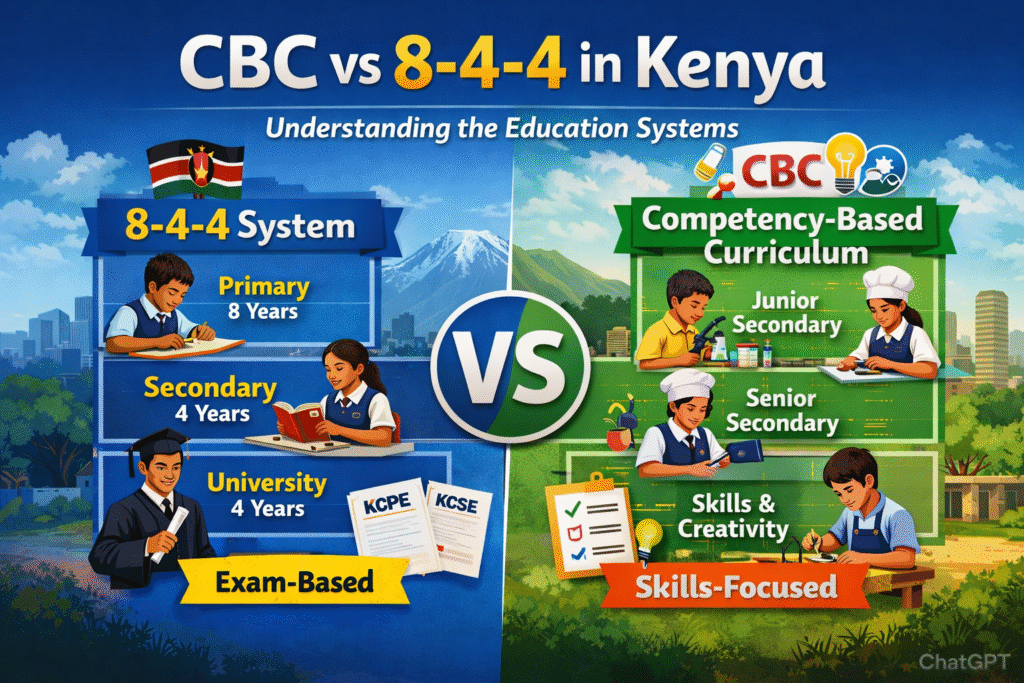
Kenya’s education landscape has undergone one of the biggest reforms in decades: moving from the traditional 8-4-4 system to the modern Competency-Based Curriculum (CBC). Many parents, learners and stakeholders still ask: What exactly is the difference? This post breaks it down clearly.
📌 What Were 8-4-4 and CBC?
🧾 8-4-4 System
The 8-4-4 curriculum was Kenya’s education structure since 1985, consisting of:
- 8 years in primary school
- 4 years in secondary school
- 4 years in university or college
Under this system, students took major national examinations — KCPE at the end of primary and KCSE at the end of secondary — which largely determined their academic progression.
🎓 Competency-Based Curriculum (CBC)
CBC is Kenya’s new education framework introduced in 2017 to replace 8-4-4. Instead of focusing on exams only, CBC aims to build skills, critical thinking and practical competencies.
Under CBC, the education cycle is:
- 2 years of Pre-Primary (PP1 & PP2)
- 6 years Primary (Grades 1–6)
- 6 years Secondary split into:
- Junior Secondary (Grades 7–9)
- Senior Secondary (Grades 10–12)
- 3 years+ University / Tertiary education
This makes CBC a 2-6-3-3-3 system compared to the old 8-4-4.
⚖️ Key Differences Between CBC and 8-4-4
| Feature | 8-4-4 System | Competency-Based Curriculum (CBC) |
| Focus | Exam-oriented, memorization | Skills, competencies & problem solving |
| Approach to Learning | Teacher-centered | Learner-centered & interactive |
| Assessment | Summative (KCPE & KCSE) | Continuous assessment, practical tasks |
| Structure | 8-4-4 (Primary → Secondary → University) | 2-6-3-3-3 (Early years to Senior Secondary) |
| Subjects vs Learning Areas | Subjects | Learning areas integrated with life skills |
| Flexibility | Fixed curriculum | Flexible pathways, specialization options |
| Parental Engagement | Limited | High – parents participate in learning assignments |
| Goal | Academic knowledge | Life competencies and practical skills |
🧩 Different Educational Philosophy
🧠 Knowledge vs Competency
Under 8-4-4, students learned what to know — focusing on memorizing content for exams. CBC prioritizes what a learner can do, emphasizing real-life abilities like problem-solving, creativity, communication, digital literacy and collaboration.
🪄 Learner-Centred vs Teacher-Centred
- 8-4-4: Teachers were the main source of knowledge and learners were passive recipients.
- CBC: Teachers play facilitator roles, guiding learners to explore and discover information.
📊 Assessment Changes: From Exams to Continuous Evaluation
Under 8-4-4:
- Students sat major national exams at specific points (Grade 8 and Grade 12).
- Performance in exams hugely determined placement in higher education.
With CBC:
- Students undergo continuous assessment, including portfolios, projects, classroom tasks and innovation activities.
- There are structured assessments at Grade 3, Grade 6, Grade 9, and Grade 12.
This shift aims to reduce exam pressure and reward development over time rather than one-time performance.
🎯 Goals of the Reforms
📈 Why Kenya Shifted from 8-4-4 to CBC
The government introduced CBC to:
- Produce holistic, skilled graduates ready for jobs and societal needs
- Build competencies relevant for the 21st century
- Encourage creativity, innovation and problem solving
- Connect classroom learning to real-life scenarios
🧠 Pros and Cons (At a Glance)
👍 Advantages of CBC
- Learner-focused, practical and skills-based
- Encourages critical thinking and creativity
- Flexible and inclusive of diverse learning needs
- Promotes parental involvement
👎 Challenges of CBC
- Requires more learning resources and trained teachers
- Transition has been costly and complex for some schools
- Some parents and teachers claim implementation is slow or inconsistent
Conclusion
The Kenyan education system has transformed from a rigid exam-based model (8-4-4) to a holistic, skills-oriented framework (CBC). While 8-4-4 served the country for decades, CBC seeks to prepare learners not just for tests, but for life, work and innovation in a rapidly changing world.
If you’re a parent or educator, understanding these distinctions will help you support learners through the new education journey.


